Is the internet truly decentralized? Here's my take
Widespread outages have taken the internet down which brings up the question, is the internet still decentralized?

When the internet first came out in August 6th 1991, it quickly became the go-to way for people and information to travel. Dot com businesses, news sites, and search engines started taking the world by storm. The internet was praised for being independent of a singular entity controlling everything. It was considered the information era. However fast-forward to the 21st century and widespread outages have taken the internet down which brings up the question, is the internet still decentralized?
First off let's analyze the statistics of today's major internet providers. AWS, the largest cloud service provider handles approximately 31% of all the cloud infrastructure on the internet. A single outage from AWS can take down some of the largest sites on the website. Cloudflare is another major provider of internet services, serving as a proxy and a content-delivery network for millions of websites (including this one).
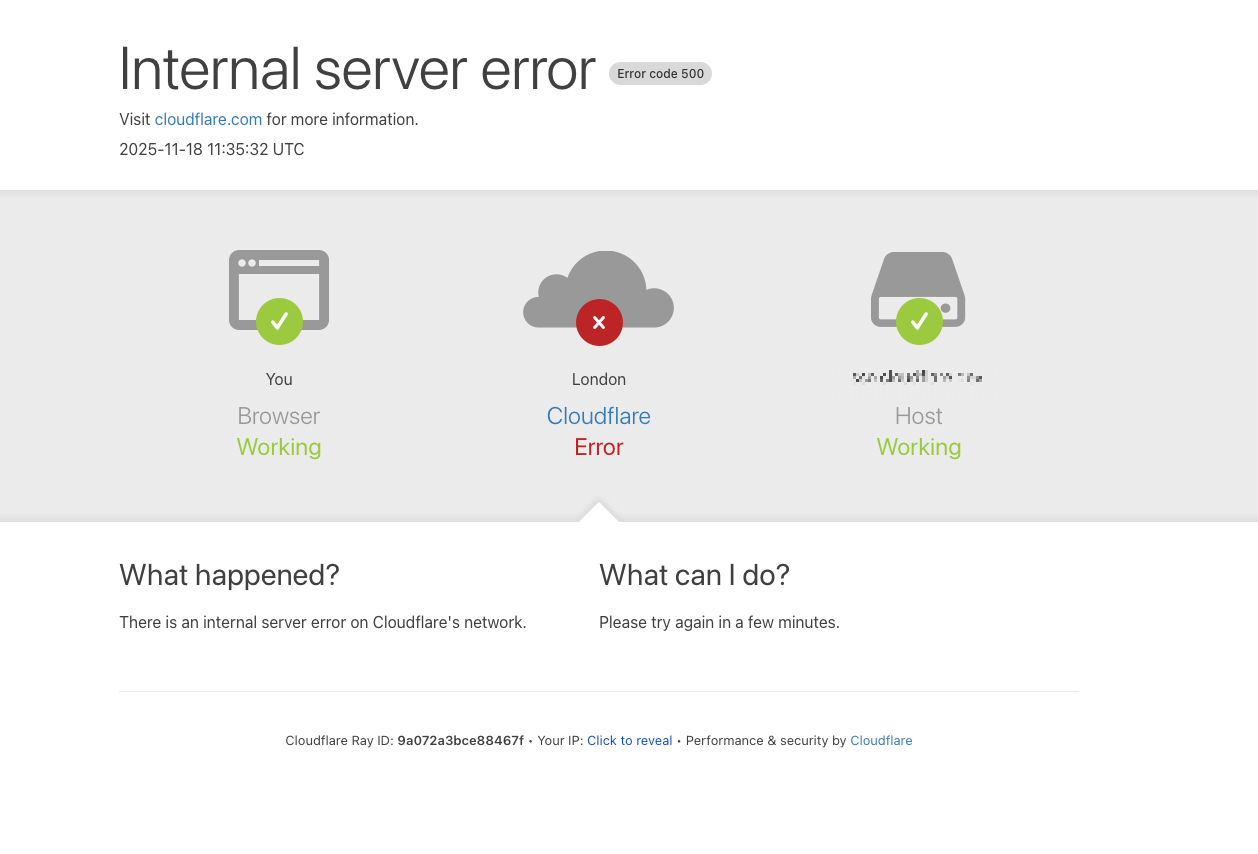
So why is this a problem? Well look at the image above. On December 5th, Cloudflare went down for the 2nd time in a 1 month period. In their statement they said "Any outage of our systems is unacceptable, and we know we have let the Internet down again following the incident on November 18," highlighting the significant impact Cloudflare holds on the internet.
Meanwhile another similar issue occurred with Amazon's outage back in October. In this case, the impact was even larger than Cloudflare's with 31% of the internet relying on the Amazon Web Services platform to operate their websites. In addition to this the "Big Three" cloud providers – Google, AWS, and Microsoft Azure hold a 60% market share on the internet's largest websites.
So if centralizing to these big three providers make the internet so decentralized to the point a significant portion of the web goes down when the internet goes down, does that mean that the internet is no longer decentralized? And if so, is that necessarily a negative thing?
The Debate over Centralization and Decentralization
As a software developer, the debate over centralization and decentralization is a common argument that frequently takes place on Hacker News such as this thread. However, as always there are two sides to the argument. One side argues that the web is already decentralized because there's always the options to use self-hosted services. But these arguments could be seen as inherently flawed, because most of their solutions require a high-level of tech knowledge and is not accessible to the general public. Many other's in the Hacker News thread argue that centralization is the solution that makes sense for the general public.

So what's my take? Well, like the common saying goes "Everything comes at a price". We could establish a decentralized internet however that could come at the cost of weaker systems and sacrificing user experience. Oftentimes smaller-scale projects and providers don't have the same level of availability as the Big Three. Back in the 90s the web was a totally different place with different needs for people. Nowadays as systems get more and more complex, compute power gets more complex.
My Experiences with Centralization
Like I mentioned at the start of this article, this very website itself runs on Cloudflare's system. But why? Because for a simple reason, if I hire a security company to protect my business, I would choose someone trustworthy and reliable, not someone I find off the street. If my friend says "XYZ" company is reliable and many other's attest to it's benefits, I would be more trusting of them to protect my website. That's what Cloudflare is for this website, without them this site would need to spend a lot of money making sure that the systems could handle attacks and large influx of traffic.
I started my first website back in 2019, back when my only experience was using websites not running them. Throughout the 6 years I spent learning web development, I started building more and more complex software requiring more and more complex systems. My needs required me to find options that were cheap and had high availability. So I chose to buy a small server and run it through that essentially avoiding Big Three services. But I still can't escape the decentralized internet. I need Google and YouTube to learn new things and handle my documents and other important files. I need Instagram, Discord and other social platforms to stay connected with my friends. Sure, I can use decentralized alternatives, but that comes at the cost of having no friends there, and oftentimes less reliability.
When I choose to make a new document, I want to use Google Docs because it's free and I can rest assured knowing my document is automatically and safely being saved to my Google Drive. The same system if I host it myself, that means I have to rely on my own uptime and pay for servers to maintain my hosted instances. All of these issues bring me to my original statement, everything comes with a cost. The cost of decentralization is accessibility and costs can often go up. Competing with corporations that have infinite amounts of money to make equally good software is difficult and it's just not possible currently. So therefore, the internet may be decentralized in the sense websites can have any host, but the internet is also centralized in the sense that big social platforms and cloud providers control most of our services.
Conclusion
Decentralization in the internet is a complex topic in the internet that's under frequent debate. Solutions for bringing back the 1990s centralized internet are all over the internet. But these solutions often have arguments where people state that they are far too complicated for the general public to use. Examples of this come from Apple whose success was from the whole purpose of taking existing systems and making them more accessible through better user interfaces. This allowed more people to get access to computers, and thus the internet. Companies opt to use the Big Three cloud providers because these providers are reliable and cost-effective compared to alternatives. For example, Cloudflare provides superior CDN and security services to anything I could produce independently for this website. So at the end of the day, the decentralization and centralization argument has no clear argument. There is debate on both sides, there are arguments on both sides. And whether or not decentralization is even a good idea is an even bigger debate in the technology spaces and increasing the digital divide on the internet.
If you have questions or comments for me or find an issue with this article feel free to email me at [email protected] or DM us on Instagram below!


Triteens Media is THE media outlet for teenagers. Stories and journalism you can trust. We report on what matters. Follow us if you want amazing reporting coming straight to your email!